

Samba Purana
साम्बपुराण
The Ancient Text of Surya Worship and Solar Devotion
The Samba Purana is a unique sacred text centered on the worship of Surya, the Sun god. Narrating the story of Samba's curse and cure through solar devotion, it encompasses the establishment of Mitravana, the arrival of Maga priests, temple architecture, tantric mantras, healing rituals, and the path to liberation through Saura Yoga.
Start ReadingAbout This Book
The Samba Purana, also known as the Sambapurana, is an Upa-Purana devoted to the glorification and worship of Surya, the Sun god. It tells the story of Samba, son of Krishna, who was cursed with leprosy and healed through devoted solar worship at Mitravana. The text uniquely documents the arrival of Maga (Zoroastrian-influenced) priests from Shakadvipa, the construction of Surya temples and idols, elaborate tantric rituals, mantric sciences, yogic practices, and the path of Saura liberation. It is an invaluable source for understanding the solar worship tradition of ancient India.
How This Book Is Organised
The Samba Purana is structured into 84 Adhyayas (chapters), encompassing mythology, cosmology, temple architecture, ritual procedures, tantric practices, and yogic philosophy.
Adhyayas
84 chapters of sacred teaching
Shlokas
Verses read one by one
Available Reading Features
This edition of the Samba Purana on Vedapath includes:

Original Sanskrit verses (Devanagari)

Transliteration for guided reading

Word-by-word meanings

Clear, faithful translations

Surya theology, Saura rituals, mantra-tantra, temple architecture, and Maga tradition
Adhyayas of the Samba Purana
The Samba Purana is composed of 84 Adhyayas.
Each Adhyaya covers mythology, cosmology, temple architecture, rituals, tantric mantras, yoga, or healing through Surya worship.

Adhyaya 0: Mangalacharanam and Anukramanika (Introduction and Index)
The chapter opens with a Mangalacharanam (auspicious invocation) by Suta, praising Lord Bhanudeva (S
Samba Purana Adhyaya 0 presents the auspicious invocation and the table of contents for the entire text, setting the stage for the discourse on Surya worship and the Saura tradition.

Adhyaya 1: Brihadbala’s Inquiry into the Supreme Deity and the Glory of Surya
In the opening chapter of the Samba Purana, Suta narrates a profound philosophical dialogue between
Samba Purana Adhyaya 1 opens with King Brihadbala’s inquiry into the supreme deity, leading to a discourse on the glory and supremacy of Surya as the ultimate cosmic principle.

Adhyaya 2: The Curse of Samba and the Establishment of Mitravana
In this chapter, King Brihadbala inquires about the primary center of Sun worship. Sage Vashistha re
Samba Purana Adhyaya 2 narrates how Samba, son of Krishna, was cursed with leprosy and how the sacred site of Mitravana was established for Surya worship and healing.

Adhyaya 3: The Twelve Manifestations of Surya and the Origins of Mitravana
In this chapter, King Vrihadbala questions Sage Vashistha about how Mitravana can be the original ab
Samba Purana Adhyaya 3 describes the twelve manifestations of the Sun god and traces the sacred origins of Mitravana as a center of solar devotion.

Adhyaya 4: The Secret of Surya’s Penance: Mitra’s Discourse to Narada
King Vrihadbala questions Sage Vasishtha about why Surya, the primordial deity, performed penance li
Samba Purana Adhyaya 4 reveals the secret of Surya’s penance through Mitra’s discourse to Narada, explaining the solar deity’s austerities and cosmic role.

Adhyaya 5: Samba’s Plea and Narada’s Revelation of Suryaloka
After receiving a terrible curse from his father, Krishna, an innocent Samba pleads for mercy, askin
Samba Purana Adhyaya 5 recounts Samba’s heartfelt plea for healing and Narada’s revelation of Suryaloka, the divine abode of the Sun god.

Adhyaya 6: Cosmology, the Omnipresence of Surya, and the Emanation of Rays and Planets
In Chapter 6 of the Samba Purana, Samba inquires about the omnipresence, forms, and divine retinue o
Samba Purana Adhyaya 6 expounds the cosmological framework, establishing Surya’s omnipresence and describing the emanation of solar rays and planetary bodies.

Adhyaya 7: The Supremacy of Surya and the Cycle of Time
In this chapter, Sage Narada instructs Samba on the supreme cosmic role of Aditya (Surya). Narada de
Samba Purana Adhyaya 7 establishes the supremacy of Surya over all deities and explains the cosmic cycle of time governed by the Sun’s movements.

Adhyaya 8: The Twelve Adityas, Etymology of Surya’s Names, and His Supreme Universality
In this chapter, Sage Narada imparts profound knowledge to Samba regarding the twelve manifestations
Samba Purana Adhyaya 8 enumerates the twelve Adityas, explains the etymology of Surya’s many names, and affirms his supreme universality across all realms.

Adhyaya 9: Genealogy of Surya’s Consorts Rajni and Nikshubha
In this chapter, Samba expresses deep devotion towards Surya after hearing Narada's discourse. He in
Samba Purana Adhyaya 9 traces the genealogy of Surya’s consorts Rajni and Nikshubha and their progeny in the solar lineage.

Adhyaya 10: The Progeny of Surya, the Illusion of Chhaya, and the Trimming of the Sun
Narada recounts the story of Surya and his wives, Samjna and Chhaya. Unable to bear Surya's intense
Samba Purana Adhyaya 10 narrates the progeny of Surya, the tale of Chhaya’s illusion, and the famous trimming of the Sun’s radiance by Vishvakarma.

Adhyaya 11: The Paring of Surya’s Radiance by Vishvakarma
In this chapter, Samba requests sage Narada to elaborate on the paring of Surya's body. Narada expla
Samba Purana Adhyaya 11 describes how Vishvakarma pared down Surya’s overwhelming radiance, shaping the excess into divine weapons and ornaments.

Adhyaya 12: The Stuti of Surya During His Shaping by Vishwakarma
In this chapter, Samba inquires about the specific hymn sung by Brahma and the Devas when Surya was
Samba Purana Adhyaya 12 presents the hymn of praise (stuti) offered to Surya during the process of his divine shaping by Vishwakarma.

Adhyaya 13: The Origin and Supreme Glory of Surya
In this chapter, Samba requests Narada to narrate more divine tales of Surya. Narada recounts a dial
Samba Purana Adhyaya 13 reveals the origin of Surya and extols his supreme glory as the source of all light, life, and cosmic order.

Adhyaya 14: The Trimming of Surya’s Radiance by Vishvakarma
In Chapter 14, Samba inquires how Surya's form was shaped. Narada recounts a time when the universe
Samba Purana Adhyaya 14 continues the account of Vishvakarma trimming Surya’s radiance and the divine instruments fashioned from the solar effulgence.

Adhyaya 15: The Eighteen Attendants of Surya and the Story of Dindi
In this chapter, Narada describes the origin and placement of Surya's eighteen principal attendants
Samba Purana Adhyaya 15 enumerates the eighteen divine attendants of Surya and narrates the story of Dindi, a devoted worshipper of the Sun.

Adhyaya 16: Dindi’s Stuti to Surya and the Glory of Avimukta Kshetra
Narada narrates to Samba the profound hymn sung by Dindi (Virupaksha/Shiva) to the Sun God, Surya. I
Samba Purana Adhyaya 16 presents Dindi’s hymn to Surya and describes the glory of Avimukta Kshetra as a sacred site of solar worship.

Adhyaya 17: Description of Vyoma, Devas, and the Planetary System
Sage Narada describes the cosmic sky (Vyoma) and its divine inhabitants. He enumerates the thirty-th
Samba Purana Adhyaya 17 describes the celestial space (Vyoma), the Devas who inhabit it, and the structure of the planetary system governed by Surya.

Adhyaya 18: Cosmological Geography and the Glory of Mount Meru
In this chapter, Sage Narada elucidates the grand cosmological structure of the universe, focusing o
Samba Purana Adhyaya 18 presents the cosmological geography centered on Mount Meru, the axis of the universe, and its relation to solar worship.

Adhyaya 19: The Orbit of the Sun and the Cities of the Lokapalas
Narada explains the cosmic geography and the apparent movement of the Sun around Mount Meru. He desc
Samba Purana Adhyaya 19 describes the orbit of the Sun through the heavens and the divine cities of the Lokapalas (guardians of the directions).

Adhyaya 20: The Architecture of Surya’s Chariot and the Solar Retinue
In this chapter, Sage Narada provides a detailed cosmological and structural description of Surya's
Samba Purana Adhyaya 20 details the magnificent architecture of Surya’s celestial chariot and the divine retinue that accompanies the Sun god.
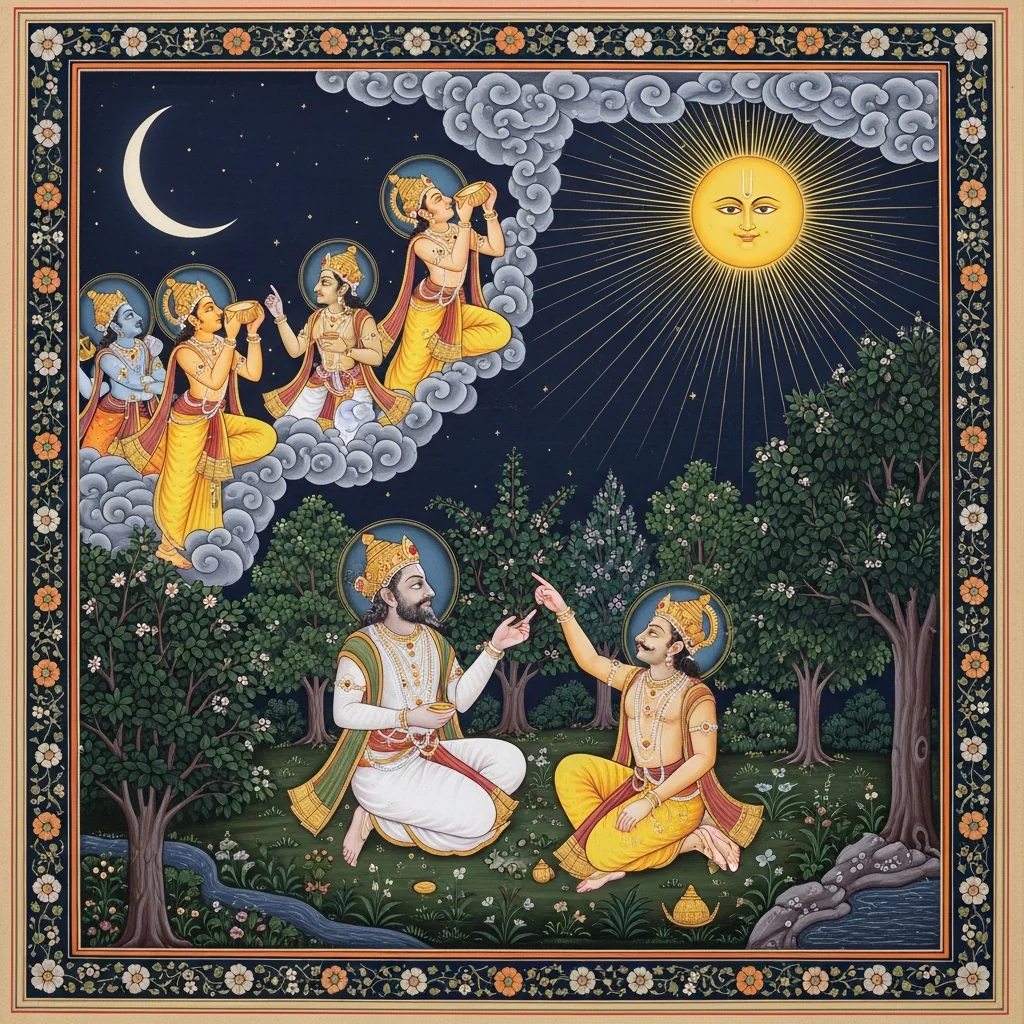
Adhyaya 21: The Lunar Cycle, the Sixteen Kalas, and the Journey to Mitravana
In this chapter, Samba asks Sage Narada about the astronomical and spiritual mechanics of the Moon's
Samba Purana Adhyaya 21 explains the lunar cycle and its sixteen kalas, connecting them to the sacred journey to Mitravana for solar worship.

Adhyaya 22: The Waxing and Waning of the Moon and the Supremacy of Surya
In this chapter, Samba inquires about the waxing and waning of the Moon (Soma). Sage Narada explains
Samba Purana Adhyaya 22 explains the phenomenon of the Moon’s waxing and waning and affirms Surya’s supremacy over all celestial bodies.

Adhyaya 23: The Phenomenon of Eclipses: The Illusion of Rahu and the Nectar of Soma
Samba asks Sage Narada to clarify a long-held doubt regarding solar eclipses: how can Rahu, a mass o
Samba Purana Adhyaya 23 explains eclipses through the illusion of Rahu and the mythological connection to the nectar of Soma.

Adhyaya 24: Samba’s Prayer to Surya and the Miraculous Cure of His Leprosy
In this pivotal chapter, Samba, deeply afflicted by leprosy and finding no relief from worldly medic
Samba Purana Adhyaya 24 narrates Samba’s fervent prayer to Surya and the miraculous cure of his leprosy through divine solar grace.

Adhyaya 25: Description of the Stavaraja Revealed by Surya
In this chapter, Sage Vasishtha narrates how an emaciated Samba continuously praised the Sun God usi
Samba Purana Adhyaya 25 presents the Stavaraja, the king of hymns revealed by Surya himself, extolling the Sun’s supreme nature.

Adhyaya 26: Maganayanam (Bringing of the Magas)
Samba discovers a divine wooden idol of Surya floating in the Chandrabhaga river and installs it at
Samba Purana Adhyaya 26 describes the Maganayanam—the bringing of the Maga priests from Shakadvipa to establish proper Surya worship rituals.

Adhyaya 27: The Significance of Magas and Yajakas and the Three Forms of Surya
In this chapter, Vashistha explains the greatness of Surya's devotees. He elaborates on the dual pat
Samba Purana Adhyaya 27 explains the significance of the Maga and Yajaka priests and describes the three forms of Surya in ritual worship.

Adhyaya 28: Saura Yoga and the Supreme State of Surya
This chapter details the path to liberation through Saura Yoga. It begins by emphasizing the transie
Samba Purana Adhyaya 28 teaches the path of Saura Yoga—meditation on Surya—and describes the supreme spiritual state attained through solar devotion.

Adhyaya 29: Rules for Sun Idol Construction and Temple Architecture
In Adhyaya 29 of the Samba Purana, Sage Vashistha explains the guidelines for constructing Surya's i
Samba Purana Adhyaya 29 prescribes detailed rules for the construction of Surya idols and the architectural principles for Surya temples.

Adhyaya 30: Rules for Selecting Wood for Surya Images (Pratima Vidhi)
In this chapter, Sage Vasishtha elaborates on the detailed injunctions for constructing sacred image
Samba Purana Adhyaya 30 specifies the rules for selecting wood and materials for crafting Surya images, as part of the Pratima Vidhi tradition.

Adhyaya 31: Pratima Lakshanam: The Characteristics and Proportions of the Surya Idol
In this chapter of the Samba Purana, Sage Vashistha details the precise iconographic guidelines (Pra
Samba Purana Adhyaya 31 details the Pratima Lakshanam—the canonical characteristics, proportions, and iconographic standards for Surya idols.

Adhyaya 32: The Ritual of Adhivasana and Installation of Surya’s Idol
This chapter details the elaborate rituals for the consecration (Adhivasana) and installation (Prati
Samba Purana Adhyaya 32 describes the Adhivasana ritual and the sacred ceremony for installing the Surya idol in a temple.

Adhyaya 33: Dhvajaropana Vidhi: The Ritual of Flag Hoisting
In this chapter, Sage Narada details the sacred ritual of Dhvajaropana (flag hoisting) atop temples,
Samba Purana Adhyaya 33 prescribes the Dhvajaropana Vidhi—the ritual of hoisting the sacred flag at a Surya temple as part of worship ceremonies.

Adhyaya 34: The Annual Ratha Yatra and Graha Shanti Vidhi
After a year of the Sun god's installation at Mitravana, Samba asks Narada about the procedures for
Samba Purana Adhyaya 34 describes the annual Ratha Yatra procession for Surya and the Graha Shanti Vidhi for planetary pacification.

Adhyaya 35: The Rituals of Ratha Yatra, Purification, and Dhupa Vidhi
In this chapter, Sage Vasishtha details the elaborate rituals for Surya's Ratha Yatra (chariot festi
Samba Purana Adhyaya 35 details the rituals of the Ratha Yatra, purification ceremonies, and the Dhupa Vidhi (incense offering) for Surya worship.

Adhyaya 36: Homa Vidhana: The Procedure of Fire Oblations to Surya
In Chapter 36 of the Samba Purana, Sage Vasistha elucidates the intricate procedures for conducting
Samba Purana Adhyaya 36 prescribes the Homa Vidhana—the detailed procedure of fire oblations (homa) dedicated to Surya for spiritual merit.

Adhyaya 37: The Fruits of Sun Worship: Devotion, Rituals, and Offerings to Surya
In this chapter, Vasistha recounts the dialogue between Samba and the sage Narada regarding the rewa
Samba Purana Adhyaya 37 enumerates the spiritual fruits of sun worship, including the merits of devotion, rituals, and various offerings to Surya.

Adhyaya 38: Saura Diksha and Mandala Vidhana
In this chapter, King Brihadbala inquires about the sacred initiation (Diksha) Samba received from t
Samba Purana Adhyaya 38 describes the Saura Diksha (solar initiation) and the Mandala Vidhana—the ritual construction and use of sacred diagrams in Surya worship.

Adhyaya 39: The Mysticism of the Sanskrit Alphabet and the Saura Mahamantra
In this chapter, Vasistha elaborates on the esoteric connection between the Sanskrit alphabet (Varna
Samba Purana Adhyaya 39 explores the mysticism of the Sanskrit alphabet and reveals the Saura Mahamantra, the great solar mantra for spiritual attainment.

Adhyaya 40: The Directional Worship of Attendant Deities and the Glory of Saura Shastra
In this chapter, Sage Vasishtha elucidates the intricate ritualistic worship (Puja) of various atten
Samba Purana Adhyaya 40 describes the worship of attendant deities in the cardinal directions and extols the glory of the Saura Shastra tradition.

Adhyaya 41: Ritual Offerings to Dikpalas and the Supreme Glory of Surya Worship
This chapter details the intricate homa (fire ritual) and bali (offerings) dedicated to the Dikpalas
Samba Purana Adhyaya 41 prescribes ritual offerings to the Dikpalas (guardians of directions) and affirms the supreme glory of Surya worship.

Adhyaya 42: The Arrival at Mitravana, Surya’s Boons to the Ascetics, and Cosmic Time
Samba, accompanied by the Maga priests, arrives at the sacred Tapovana on the shores of the salt oce
Samba Purana Adhyaya 42 narrates the arrival at Mitravana, Surya’s boons granted to the ascetics, and teachings on cosmic time cycles.

Adhyaya 43: The Establishment of the Surya Idol at Mundira
Vasistha describes a sacred grove on the ocean shore where gods, sages, and celestial beings eagerly
Samba Purana Adhyaya 43 describes the sacred establishment of the Surya idol at Mundira, a significant event in the solar worship tradition.

Adhyaya 44: Sadachara Varnana: The Rules of Righteous Conduct for Surya Devotees
The chapter begins with Sage Vasishtha glorifying Surya. Samba then inquires about Achara (proper co
Samba Purana Adhyaya 44 prescribes the Sadachara Varnana—rules of righteous conduct and daily observances for devoted worshippers of Surya.

Adhyaya 45: The Origin and Merit of Donating Umbrellas and Sandals
In this chapter, Samba inquires about the merit of donating umbrellas and sandals. Narada narrates t
Samba Purana Adhyaya 45 explains the origin and spiritual merit of donating umbrellas and sandals as acts of charity connected to Surya worship.

Adhyaya 46: The Rites and Rewards of Saptami Vrata and the Twelve Forms of Surya
In this chapter, Samba inquires about the rules of the Saptami Vrata. Sage Narada details the seven
Samba Purana Adhyaya 46 describes the rites and rewards of the Saptami Vrata and enumerates the twelve forms of Surya worshipped through the year.

Adhyaya 47: Japa Yajna Vidhi: The Procedure of Chanting
In Chapter 47 of the Samba Purana, Sage Narada elucidates the supreme importance and detailed method
Samba Purana Adhyaya 47 prescribes the Japa Yajna Vidhi—the procedure and rules for the chanting sacrifice dedicated to Surya.

Adhyaya 48: The Characteristics and Formation of Sacred Mudras
This chapter details the specific hand gestures (Mudras) used in the ritualistic worship of Surya. I
Samba Purana Adhyaya 48 describes the characteristics and formation of sacred mudras (ritual hand gestures) used in Surya worship.

Adhyaya 49: Daily Solar Rituals and Purification Rites (Shaucha Vidhi)
In this chapter of the Samba Purana, Sage Narada outlines the essential daily rituals (Ahnika) and p
Samba Purana Adhyaya 49 prescribes daily solar rituals and the Shaucha Vidhi—purification rites for maintaining spiritual cleanliness in Surya devotion.

Adhyaya 50: The Rituals of Mantras, Mudras, and Nyasa in Sun Worship
In Adhyaya 50 of the Samba Purana, the narrative transitions into the esoteric and ritualistic dimen
Samba Purana Adhyaya 50 details the combined rituals of mantras, mudras, and nyasa (ritual placement) in the practice of sun worship.

Adhyaya 51: The Ritualistic Worship of Khakholka Surya and His Cosmic Manifestations
Adhyaya 51 of the Samba Purana provides a highly detailed exposition on the ritualistic worship (Puj
Samba Purana Adhyaya 51 describes the ritualistic worship of Khakholka Surya, a specific form of the Sun god, and his cosmic manifestations.

Adhyaya 52: The Construction of the Surya Mandala and Saura Initiation (Diksha)
Chapter 52 of the Samba Purana outlines the esoteric procedures for constructing a sacred Saura Mand
Samba Purana Adhyaya 52 details the construction of the Surya Mandala (sacred solar diagram) and the Saura Diksha initiation ceremony.

Adhyaya 53: Ritual Worship and Offerings to Surya
In Adhyaya 53 of the Samba Purana, Sage Narada details the systematic ritual worship (Puja) of the S
Samba Purana Adhyaya 53 prescribes the ritual worship procedures and various offerings to be made to Surya for spiritual benefit.

Adhyaya 54: Ashtapushpika Vidhi: The Eight-Flower Seed Mantra Ritual
This chapter details the esoteric Ashtapushpika or eight-flower ritual dedicated to the Sun God, Sur
Samba Purana Adhyaya 54 describes the Ashtapushpika Vidhi—the ritual of the eight flowers combined with seed mantras for invoking Surya’s blessings.

Adhyaya 55: The Construction of the Surya Mandala, Diksha Vidhi, and the Esoteric Creation of Mantras
Chapter 55 of the Samba Purana details the highly specialized and esoteric rituals of Saura worship.
Samba Purana Adhyaya 55 continues with advanced mandala construction, the Diksha Vidhi, and the esoteric process of creating sacred mantras.

Adhyaya 56: The Esoteric Heart-Lotus and Bija Mantras of Surya
Adhyaya 56 of the Samba Purana delves into the esoteric and Tantric dimensions of Saura worship, foc
Samba Purana Adhyaya 56 reveals the esoteric heart-lotus meditation and the powerful Bija mantras associated with Surya worship.

Adhyaya 57: Tattva-Jnana and the Origin of Bija Mantras
This chapter delves into the esoteric science of sound and the origin of the Sanskrit alphabet (Varn
Samba Purana Adhyaya 57 teaches Tattva-Jnana (knowledge of cosmic principles) and traces the origin of Bija mantras from primordial sound.

Adhyaya 58: Jnanottara: The Generation of Bija and Svara
This chapter details the esoteric construction of a sacred forty-syllable mantra, focusing on the my
Samba Purana Adhyaya 58 presents the Jnanottara teaching on the generation of Bija (seed syllables) and Svara (tonal elements) in mantric science.

Adhyaya 59: Mantra Vidhana and the Principles of Cosmic Creation
Adhyaya 59 of the Samba Purana concludes the sixth Patala, focusing on the esoteric construction of
Samba Purana Adhyaya 59 describes the Mantra Vidhana (mantra procedures) and their connection to the principles of cosmic creation.

Adhyaya 60: The Kala Chakra and Mantric Manifestation of Surya
This chapter explores the profound connection between cosmic time and esoteric mantra science within
Samba Purana Adhyaya 60 explains the Kala Chakra (wheel of time) and the mantric manifestation of Surya through sacred syllables.

Adhyaya 61: Esoteric Mantras, Nyasa Vidhi, and Ritual Vratas
This chapter delves into the esoteric and tantric dimensions of Saura worship. It meticulously outli
Samba Purana Adhyaya 61 teaches esoteric mantras, the Nyasa Vidhi (ritual placement of mantras on the body), and ritual vratas for spiritual advancement.

Adhyaya 62: Rituals for Curing Diseases and Removing Obstacles
Adhyaya 62 of the Samba Purana outlines specialized ritualistic treatments for practitioners (sadhak
Samba Purana Adhyaya 62 prescribes rituals for curing diseases and removing obstacles through the power of Surya mantras and worship.

Adhyaya 63: Abhicara Vidhi: The Rituals of Destructive Magic
Adhyaya 63 of the Samba Purana details the esoteric and fierce rituals of Abhicara (destructive magi
Samba Purana Adhyaya 63 describes the Abhicara Vidhi—rituals of destructive magic and their controlled use within the tantric Surya tradition.

Adhyaya 64: The Ritual of Kilana and Mantric Eradication of Diseases
Adhyaya 64 of the Samba Purana outlines esoteric Tantric and Mantric procedures for curing diseases
Samba Purana Adhyaya 64 describes the Kilana ritual and the mantric methods for eradicating diseases through solar tantric practice.

Adhyaya 65: Healing Rituals and the Vrata of the Mantrin
This chapter outlines the rigorous Vrata (vow) and healing rituals (Chikitsa) to be undertaken by a
Samba Purana Adhyaya 65 prescribes healing rituals and the vrata (sacred vow) to be observed by the Mantrin, the practitioner of sacred mantras.

Adhyaya 66: Mantra Sadhana and Tantric Vratas
Chapter 66 of the Samba Purana outlines advanced Tantric and Mantric rituals (Sadhana) for spiritual
Samba Purana Adhyaya 66 teaches mantra sadhana (spiritual practice through mantras) and the tantric vratas required for mantric mastery.

Adhyaya 67: Mantra Sadhana, Nyasa Vidhi and the Attainment of Siddhi
This chapter provides a detailed exposition on Mantra Sadhana, outlining the rituals, vows, and medi
Samba Purana Adhyaya 67 continues the teaching on mantra sadhana and nyasa vidhi, culminating in the attainment of siddhi (spiritual powers).

Adhyaya 68: The Path of Yoga and Initiation for Supreme Liberation
This chapter outlines the systematic spiritual path to attain the supreme abode, referred to as Shiv
Samba Purana Adhyaya 68 describes the path of yoga within the Saura tradition and the initiation required for attaining supreme liberation.

Adhyaya 69: The Science of Bija Mantras and Sacred Syllables
This chapter explores the esoteric science of Bija Mantras (seed syllables) and Japa (chanting) inte
Samba Purana Adhyaya 69 expounds the science of Bija mantras and sacred syllables, revealing their cosmic correspondences and spiritual power.

Adhyaya 70: The Ritual of Bija Mantra Nyasa and Syllabic Placement
The 70th chapter of the Samba Purana delves into the esoteric practices of Bija Mantra and Nyasa (ri
Samba Purana Adhyaya 70 details the ritual of Bija mantra nyasa—the systematic placement of seed syllables on the body for spiritual empowerment.

Adhyaya 71: Varna-Nyasa Vidhi: The Mystic Placement of Syllables
In Adhyaya 71 of the Samba Purana, the text shifts to the esoteric and ritualistic dimensions of Sau
Samba Purana Adhyaya 71 prescribes the Varna-Nyasa Vidhi—the mystic placement of syllables (varnas) on the body as part of tantric solar worship.

Adhyaya 72: Mantra Nyasa Vidhi and the Syllabic Forms of Surya
This chapter outlines the esoteric ritual of Nyasa (the placement of mantras on the body) and the fo
Samba Purana Adhyaya 72 describes the mantra nyasa vidhi and reveals the syllabic forms through which Surya is invoked in esoteric practice.

Adhyaya 73: Description of the Mystic Matrices (Yonis) and Mantric Syllables
Chapter 73 of the Samba Purana delves into the esoteric dimensions of Saura worship, detailing the v
Samba Purana Adhyaya 73 describes the mystic matrices (yonis) and the mantric syllables that form the foundation of advanced Saura tantric practice.

Adhyaya 74: The Fourfold Initiation and Ritual Purification
In this chapter, the focus shifts to the esoteric practices of Saura Dharma, specifically the fourfo
Samba Purana Adhyaya 74 describes the fourfold initiation ceremony and the ritual purification required for advancing in Saura spiritual practice.

Adhyaya 75: Diksha Vidhi and Spiritual Sacraments of the Disciple
Adhyaya 75 of the Samba Purana details the profound initiation rituals (Diksha) and spiritual sacram
Samba Purana Adhyaya 75 prescribes the Diksha Vidhi (initiation procedure) and the spiritual sacraments that mark the disciple’s progress.

Adhyaya 76: The Initiation Ritual and Consecration of the Disciple
Adhyaya 76 of the Samba Purana details the esoteric Samskara (initiation) rituals aimed at cutting t
Samba Purana Adhyaya 76 details the initiation ritual and the consecration ceremony that formally admits the disciple into the Saura tradition.

Adhyaya 77: The Path of Sannyasa (Renunciation)
This chapter details the path of Sannyasa (renunciation) within the Saura tradition. It outlines the
Samba Purana Adhyaya 77 describes the path of Sannyasa—renunciation of worldly life—within the framework of the Saura spiritual tradition.

Adhyaya 78: The Ritual of Withdrawal and Nyasa-Nivartana
In this chapter, the Samba Purana details the specific rituals for a practitioner seeking withdrawal
Samba Purana Adhyaya 78 describes the ritual of withdrawal and Nyasa-Nivartana—the systematic reversal of mantric placements at the conclusion of practice.

Adhyaya 79: The Yogic Method of Immediate Liberation (Sadyomukti) and Piercing the Brahmarandhra
Adhyaya 79 of the Samba Purana details the esoteric yogic process for attaining immediate liberation
Samba Purana Adhyaya 79 teaches the yogic method of Sadyomukti (immediate liberation) through piercing the Brahmarandhra—the crown aperture.

Adhyaya 80: Tantric Rituals, Mantra Application, and Ascetic Practices in Sun Worship
This chapter details the highly esoteric and Tantric aspects of Surya worship. It begins by explaini
Samba Purana Adhyaya 80 describes advanced tantric rituals, mantra application techniques, and ascetic practices within the solar worship tradition.

Adhyaya 81: Internal Worship and the Eight Flowers of Devotion
This chapter transitions from esoteric mantras to the profound philosophy of internal worship (Manas
Samba Purana Adhyaya 81 teaches the practice of internal worship (antarayaga) and the eight flowers of devotion offered to Surya in the heart.

Adhyaya 82: The Path of Yoga, Knowledge (Jnana), and the Mastery of Senses
Adhyaya 82 of the Samba Purana elucidates the profound synthesis of Yoga, Jnana (knowledge), and Kar
Samba Purana Adhyaya 82 synthesizes the paths of yoga and jnana (knowledge), teaching the mastery of senses as the foundation for solar realization.

Adhyaya 83: Causes and Cures of Diseases through Surya Worship
Samba inquires from Sage Narada about the karmic causes behind severe afflictions like leprosy among
Samba Purana Adhyaya 83 concludes with the causes and cures of diseases through the power of Surya worship, mantras, and solar healing rituals.
Frequently Asked Questions
The first chapter serves as an introduction and index, invoking Lord Surya as the healer of diseases like leprosy and outlining the Purana's contents, including Samba's curse, the Maga priests, and detailed Sun worship rituals.
The narrator, Suta, is addressing the assembled Rishis (sages), introducing them to the sacred and disease-curing Samba Purana.
The chapter mentions Samba being cursed by his father (Krishna) due to Narada's instigation, his subsequent redemption, and the establishment of a Sun temple and city.
King Brihadbala asks about the eternal Supreme Brahman, the ultimate deity to worship for liberation across all life stages, and the origin of the universe.
Sage Vashistha describes Surya as the visible Supreme Deity (Pratyaksha Devata), the creator, sustainer, and destroyer of the universe, and the ultimate destination for yogis.
The text explains that enlightened beings like Shuka, Vyasa, and the Valakhilyas entered the solar orb (Surya Mandala) through yoga, achieving ultimate liberation.
Krishna cursed Samba because his unparalleled physical beauty caused Krishna's intoxicated wives to become infatuated and agitated. This situation was orchestrated by Sage Narada, whom Samba had previously disrespected.
Krishna cursed his wives, except Rukmini, Satyabhama, and Jambavati, to lose their heavenly realms and be abducted by thieves after his death, as a consequence of their intoxication and loss of modesty.
To cure his leprosy, Samba worshipped the Sun God and established a permanent center for Surya worship called Sambapura, located on the picturesque banks of the Chandrabhaga river.
It is called Mitravana because Mitra, the twelfth manifestation of the Sun God (Surya), performed severe penance there to bless his devotees, making it his primordial abode before Samba rebuilt it.
Read Samba Purana in the Vedapath app
Scan the QR code to open this directly in the app, with audio, word-by-word meanings, and more.